
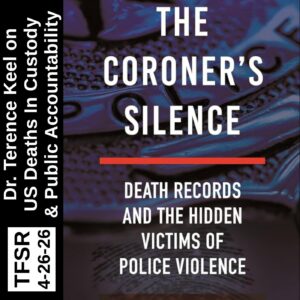
This week, we’re sharing this interview with Dr. Terence Keel, author of The Coroner’s Silence: Death Records and the Hidden Victims of Police Violence (Beacon Press, 2025). We speak about the book, the BioCritical Studies Lab that Dr. Keel founded, what public records exist of deaths at the hands of police, jails and prisons and some efforts to record names and circumstances in hopes of accountability and closure. You can find Dr. Keel at TerenceKeel.com
. … . ..
Featured Track:
- TFSR by The Willows Whisper
. … . ..
Transcription
TFSR: I’m speaking with Dr. Terence Keel, a professor of Human Biology, Society and African American Studies at UCLA. His latest book is The Coroner’s Silence: Death Records and the Hidden Victims of Police Violence. Thank you, Dr. Keel, for joining me on this call. I don’t know if there’s any further introduction you want to give to yourself.
Dr. Terence Keel: First of all, thank you for having me. I think you covered the bases.
TFSR: Would you speak a bit about the intersections of your academic work focusing on human biology, society and African American studies, how the BioCritical Studies Lab came to be, and what it does?
TK: I’m a historian of science, medicine, American history, religion and the law, and those are lots of different intersections. What I really am interested in is how science reflects society, and how science reflects our cultural values and our belief systems. It’s a really important point because we have been socialized to think of science and medicine as this sort of objective, value-neutral thing that stands outside of society and gets to absolute, universal truths. While I think that’s a very admirable idea for thinking about Western science and medicine, the reality is much more complicated. What I try to do in my work is to reveal these connections between the societies that we create and design, and how those societies shape the kinds of questions, ideas, assumptions, and the belief systems that appear within medicine, particularly science and biology. I founded the UCLA Lab for BioCritical Studies in 2020. There are a couple of things that inspired me to create this lab. One is Frederick Douglass. Frederick Douglass, as many of us know, was a giant in American history. He was a noted abolitionist who delivered this very powerful speech in Hudson, Ohio on the 12th of July, 1854. It was titled “The Claims of the Negro, Ethnologically Considered.” He is having a larger conversation about how Americans have this very narrow idea about what it means to be human. And that matters, because democracy, at its core is about allowing different types of people to thrive and to flourish, and that can’t happen if we carry very narrow ideas about what it is to be a human being in the world.
But he makes this really important point that I don’t think we pay enough attention to. He says, “I have spent time in Ireland looking at the weathered Irish people who are under British occupation, who are under the imperialism of the Empire. And their shoulders are hunched, their feet are flat, their faces are worn and weathered, and they look a lot like Black Americans who are also under the empire of slavery in America.” What he realizes is that these are not innate dispositions or innate features of these people. Instead, these are features of people who are under oppression, and that the body actually changes given the social-political systems that are around it. I’ve always been inspired by this passage from Douglass in this really powerful speech, because it has given me a window into thinking about our social systems here in the United States that weather and wear down people—particularly people who are on the margins politically. I created a lab to look at this complex interaction between society and human biology.
I mentioned that I founded this in 2020 and that was after the public murder of George Floyd, where all of us watched that terrible video of him having his life taken from him by Derek Chauvin and the other officers in Hennepin County. To witness this death and see the death investigators who wrote his autopsy say that he died of a homicide but also try to say he had a bad heart, fentanyl intoxication, and was a carrier of sickle cell trait revealed an effort to say that something about his biology was why he died. It wasn’t just the police. It was something else. That, for me, was a was a really kind of clarifying moment that had me say “something’s wrong with medicine and science here. We can’t properly diagnose when state violence is ending our lives. How many more George Floyd’s are there?” I started to ask that question. What I discovered terrified me, I decided to write a book about it, and that book is The Coroner’s Silence.
TFSR: Thank you for sharing that story. It’s really profound. A lot of what the book talks about is a deeper study into how death examiners and government officials explain the deaths of people, based either in this sort of biological trajectory or some choices that get cherry picked and put into the story of how they got to a slab in front of the medical examiner. I really appreciate how your book sort of touches on—even if it can’t get into too much detail—how this misses huge parts of the story. Clearly, we’re going to talk a lot about the role of the medical examiner and the stories that are told out of deadly interactions with state apparatus in the US. But I wonder, does the lab also approach other ways of measuring or looking at outcomes in terms of access to medical care? Questions such as what opportunities are available to people, and how this shapes the consistency, length or quality of their life?
TK: Sure. The lab is staffed by brilliant student researchers at UCLA and our community partners around the country. Specifically, here in Los Angeles, we have an amazing partnership with a local organization called Dignity & Power Now, where we have been working with families who have been impacted by police violence. Helen Jones just has been a key partner. We can talk a little bit more about her work and her story. Your question is how do we think about the larger history of people’s lives before they end up dying in police custody or just in general? That’s a really great question, and it’s an important one. It is something that we think about and we try to measure and study, because you can’t really understand something like state violence, substance abuse, mental illness or being unhoused in a vacuum. You have to understand that these are social outcomes that have been engineered as a result of policy decisions, urban planning, economic divestment, and the erosion of the social safety net. Things like: health care, mental health services, shelter, affordable housing, wages that allow people to live with dignity – when you pull all those things away, they have a cascading effect. They push people to the margins. They make people vulnerable.
What we have realized in the work—and what I, as a scholar, have been thinking about and writing about for many years now—is that when you have a system that is structured to create inequality, that inequality appears in our bodies. The challenge is whether or not we have the moral clarity and the right tools to measure that inequality in its origins, and it’s too often we pivot to genes or to biology, which doesn’t actually tell us the full story. It’s important that we think about biology as an outcome. If you think about the equation of what it is to be human, it is having a body plus living in a society, plus whatever you inherit from your family, plus the local county or city that you live in, equals biology. Biology is an outcome of all of these other things that come together, and we often get it the other way around. We think that biology is who you really are. It’s the core of or the essence of your being. It comes from nature or it comes from God in some people’s imagination. That actually isn’t what biology is. Biology is this constantly changing thing. It varies based on what you eat, the water you drink, the air that you breathe and the lifestyle that you’re afforded or not, and whether or not you’re living in environments that are overpoliced or environments that are in food deserts or heat islands, etc. All of these things are changing our biology. As a scholar and educator, I’ve been teaching young minds for decades how to understand the history of America in a way that gives us clarity and tools to diagnose what it really means to be an American and to have the ability to thrive, or, tragically, in some cases, lose our lives early.
TFSR: I would like to speak about Helen Jones and her work. But first, would you sort of set the stage in terms of the civil service of the death examiner in the US. How is it set up, who does the job, and how has it changed over time?
TK: Sure. The coroner is one of the oldest democratic institutions in American society. It comes from English law. Before the US became an independent nation state and was a colony, the crown of England would send people that were called “crowners.” If someone had been given an advance, or if there was a material investment from the crown to develop a plantation to extract resources or crops, etc., and that person died, the crowners job was to come to various outposts in the colony and investigate if that person had perished and debts were owed back to the crown. The job of the crowner was to investigate how this person died, what those debts were, and to make sure that those resources returned back to England. After American independence, when we supposedly emancipated ourselves from a king, the nation as an independent entity didn’t need crowners any longer. But they did still need someone to investigate sudden, mysterious or untimely deaths, and those people were called coroners. The word coroner comes from crowners.
What early American coroners did is that they would gather an inquest jury. An inquest jury was made up of 12 citizens whose job it was to investigate the conditions before, during and after someone died in a county, city, parish or township. These were free white male citizens, because they were the people who counted as citizens in the early history of our republic. But they worked directly with the coroner, which is to say they came together and tried to kind of work collectively to understand who’s accountable, who needs to be charged and what the sentencing should be. This information would be given to the coroner, and the coroner would then go tell the sheriff, “arrest John Doe for killing this individual.” This was a direct experiment in direct democracy. After 1865, we begin to see that the coroner’s role shifts a bit. After the emancipation of African Americans, states around the US begin to transition the coroner out of this sort of direct role of democracy—which, by the way, early coroners didn’t have to be doctors or physicians. They could be career politicians or business people. In fact, the first coroner in Los Angeles—once it came under control of Anglo-American rule after the 1850 acquisition of California from Mexico— was Alpheus Hodges, but he was also the first mayor. It could be an opportunity for political mobility. After emancipation, what we begin to see throughout the nation is that coroners start being required to have medical licenses, and they begin to get removed a little bit further away from the public. So they’re not so embedded in thinking about criminal prosecution and charging who’s accountable for early and untimely deaths. On the one hand, this is a bit of a benefit in that if you’re going to have someone investigating the death of an individual, it’s better to have that person trained in science and medicine. By the end of the 19th century, American medical institutions are becoming kind of premier academic institutions, and physicians gain a lot of power in our country near the end of the 19th century. They wanted people who were investigating deaths to have proper medical licenses. That’s a good thing, right?
The downside of this is that as doctors became coroners, they were no longer involved in direct democracy, meaning that the inquest juries became less of a prominent feature. And when they were held, they were not so influential in determining who was charged and who was going to be prosecuted. That would become the responsibility of state’s attorneys and district attorneys as we move deeper into the end of the 19th century and the middle of the 20th century. By the time we get to the 1940s, 1950s, most states in the US have a medical examiner system that’s completely insulated from the general public. Why this matters is that in our current moment, when someone dies from police violence during arrest or in jail, medical examiners rarely hold inquest. When they do, they are what I call political pageantry. They are the appearance of democracy, but in practice, very anti-democratic. The public is not allowed to ask questions at these inquest hearings, the victims families are not allowed to engage with law enforcement or the medical examiner.
The job of these inquests—which are usually presided by some sort of judge—is to make sure that law enforcement did their due diligence and followed the law, and that the medical examiner, when investigating the death of a body, followed the letter of the law. But the point of these juries or inquests is not to actually determine liability and fault. It’s a problem because this is what the public wants. This is what grieving families want. They want to know, “who killed my daughter or my son or my father or my brother”, and who was responsible. But these inquests don’t do this any longer. And what that has created over time is distrust, resentment and a profound sense that this is a system that is pretending to be democratic, but in reality, is something that is undermining the public’s ability to get justice. As I was writing about inquest juries and the effort of local judges in different parts of the country to investigate cases of people dying in police custody, I noted the number of times that families and communities felt completely failed by the justice system. Because not only do they lose a loved one to law enforcement, but the legal reckoning of this death doesn’t actually create the kind of closure and clarity that the public wants.
TFSR: Maybe this is a good time to bring up Helen Jones then. With folks who have lost loved ones in interactions with the police or while in custody— what sort of recourse do they have? I know that sometimes people will hire for independent autopsies, which I’m sure is not an inexpensive thing. Could you talk about what recourse people follow, and the path that Helen and her organization took?
TK: Families don’t have a lot of options, and the options that they have available to them depends on what state they live in. This is something really important that I don’t think the general public is aware of. When you look across all the laws that govern inquests and the work of the medical examiner, in only 20 states can the medical examiner or coroner call an inquest to actually investigate what the circumstances were when someone died during police custody, during arrests or in jail. In the rest of the country, either the medical examiner does not have this ability to call an inquest, and some other state official can, such as a mayor, a governor, or most often a district attorney, or it’s been completely abolished and is not available at all. If you’re living in Arizona, Arkansas, West Virginia or Mississippi, you can’t have an inquest. There is no public inquest in those states. Or, the state law is unclear about whether or not an inquest is possible. Why this matters is that the ability of Americans to hold local officials and law enforcement accountable for killing members of their community is not uniform. It’s not the same. We’re dealing with a system that has significant amount of variability across all 50 states. This creates inequality inherently, because we’re dealing with people who don’t have the same rights depending on what state boundary you happen to cross or to live in.
Helen Jones has been my trusted community partner and we’ve been in the thick of it together since 2020 trying to create accountability here in Los Angeles. She lost her son, John Horton III, on March 30, 2009 and he had been placed in solitary confinement following a health incident. He was at home sick. Family calls paramedics. Police come. They believe he’s suffering from PCP overdose, which was not the case. They arrest him and put him in jail, and throw him in solitary confinement. He doesn’t get the medical treatment that he deserves. The medical examiner—and the sheriff’s office, after several months—claims that John hangs himself in solitary confinement. When Helen Jones gets the body of John at the mortuary here in Los Angeles, she sees that John has a tremendous signs of violence. The bridge of his nose is busted open. His lips clearly have recent lacerations. There’s hematomas all over his face and shoulders. There’s abrasions all over his body. He’s got recent blunt force trauma in his back – all injuries that could not have happened to someone who was alone in solitary confinement. Then she gets a secondary autopsy, which is a very difficult and expensive thing to do. Not every family has the resources or the means to do this. Not to mention, most people have been socialized to believe the findings of the medical examiner. After all, these are objective, value-neutral people of science and medicine who are supposed to be giving us truth. In this instance, that belief is being exploited when medical examiners are silent, when they don’t actually tell us the truth, and they come to determinations that favor police and not the public.
In John’s case, the local medical examiner claimed that it was suicide. But when Helen pushed back and she drew attention to the violence that was on his body, sat with the medical examiner and was asking questions, the medical examiner changed the determination from suicide to undetermined. He acknowledged that these things couldn’t have happened to someone who was in solitary confinement, and that it appeared that potentially, from the medical examiner’s perspective, something else must have happened. He must have been a target of some sort of violence.
Her story is important for us because not everyone is going to have a Helen Jones in their family or in their community. She’s a unique person in a system where every day at least five people are dying in police custody either during arrests or in jail. If you think about it, that’s a staggering number, and we don’t currently have a third party review system that can provide a check or balance to the work of the medical examiner. This is part of the problem, and this is part of what we need to confront collectively. If I were to publish a peer reviewed journal article it would have to go through at least three rounds of blind peer review. A medical examiner writes a final death record explaining the manner and cause of death, and there isn’t a single peer review system at all. They may have a colleague. They may consult about a particular component of the autopsy like the toxicology report. They might consult a cardiologist if the person had a heart condition. But there isn’t an independent panel that will review that record, and that record will go into official records and be the final word about what happened at the end of this person’s life.
And to sort of end on this point, the manner of death that the medical examiner arrives at also is a huge component here. Because if the medical examiner says that the person died of homicide, that gives a family leverage to get a lawyer to do an investigation and file a lawsuit, because a homicide means that this person was killed. Then the question becomes, “well, who killed him?” Especially if this person was in solitary confinement. If the medical examiner instead declares this person died of natural causes or from suicide, then that takes accountability away from police or the deputies that are in jail or law enforcement more generally, and it puts the responsibility back on the victim. What I found working with Helen Jones and members of my lab is that too often people are being killed during arrests or in jail, particularly African-American or Latino people, especially men. And those deaths are being classified either as natural or being classified in ways that minimize the accountability of law enforcement. This is a system that’s broken. It’s a system that’s corrupt, and it’s a system that isn’t serving the public. It’s not protecting us against lethal state violence.
TFSR: Your point is well taken, especially concerning proportionality for African-American men and Latinx men. However, as you point out in the book too, it’s not just those populations. It seems to relate to proximity to power generally. It does include a lot of white folks, a lot of Asian-Pacific Islanders, a lot of Indigenous folks. But proportionally within the US, it reflects that sort of disproportionate weight on black and brown men, right?
TK: Yeah. That’s a great point. When I talk about this work, I say there is no question we have a criminal justice system that is racist, has been since the beginning, and disproportionately targets and impacts Black, Latino and other people of color. There’s no question about that. I pulled together multiple data sets and looked at just the people who died during arrests. So not even jails and certainly not prisons but just arrests. Between 2000 and 2020 there were 32,103 people that died during arrest during that time period. When I look at the raw numbers the majority of those deaths, 34% of them, are white Americans. When I say this people are surprised, but I’m always struck by the surprise. Because there’s an assumption that our criminal justice system for the most part just targets black and brown people. So if you’re white, you’re protected from state violence and you’re insulated from the system that dismembers people and then erases the hands of the state and their involvement in this dismemberment. But that’s a mythology that prevents us from really confronting the system that is terrorizing all of us. It’s important. Yes, this criminal justice system is racist. But it has also evolved to target and identify any person that presents a threat, appears to be disordered, or appears to not be behaving in ways that the state believes that we should be behaving. They can be arrested – in many cases, violently arrested and killed. This is something that should be drawing a collective alarm. We all have to be collectively involved in this system, so that white Americans can’t think, “oh, this is just a problem that’s out there in the world, and I am insulated from that.” Well, the deaths of Renee Good and Alex Pretti should be a wake up call, if that is what you believe. For black Americans and Latinos, it’s an opportunity for us to find forms of solidarity that cut across racial divisions, and to realize that this is a collective democratic crisis. If we’re going to get out of it, we have to work together.
TFSR: We’re taught via the media and in our schools that police are here to serve and protect the innocent, and that the courts sentence people guilty of crimes to remand in jails or prisons for set sentences and set repercussions. In your research and working with the BioCritical Studies Lab, what did you find about this? You just named a number— 32,000 — within those few years. How many people die at the hands of the US government each year within the USA and what can you say about the circumstances?
TK: When I did this work, it was very difficult. I thought there had to be some government agency, at least at the federal level, that is documenting the number of people that are dying during arrests or in jail. What I discovered was shocking. There actually is not. There is not a single government institution in America that can tell you the total number of people that have died during arrests. There are government institutions that can tell you people that we’ve executed. And that number going back to 1608 is around 16,032 people, according to my last look at the figures. Now that just includes official executions, but doesn’t include racial lynching, which we know was another form of public execution. We do have data tracking for that. But we don’t have data tracking for people that die during arrests or in jail. And the question is, why? The answer that I have come up with is that we count the things that matter. We count the things that we believe we should keep a record of, or that the state is forced to keep a record of.
It wasn’t until 2000 when Congress decided that it would be in its best interest to begin tracking the number of people that have died in jail or during arrest. Congress passed the Death in Custody Reporting Act (DCRA). It’s an act that requires law enforcement to report annually to the Department of Justice the names of the people that die in their custody. Now, just think about that. It is a law that on the surface is giving us transparency and accountability, but gets undermined by the fact that we are essentially asking the agents that are killing people to tell on themselves and report those names. Not to mention that when Congress passed DCRA in 2000 they did it on a shoestring budget, and they didn’t actually provide clear directions on what to do with the data and how to collect the data. This is a data-gathering effort. If you’re going to ask police departments and sheriff’s departments around the country to report the names of people that die in custody, you don’t just need names. You need race, age, gender, manner and cause of death, and other identifying details so that researchers, lawmakers, and concerned community members can look at the data and identify patterns to identify what’s going on. None of that happened when Congress passed DCRA in 2000 and they had to revise DCRA later in 2012-2013 to get more specificity about the kind of information that was required. Even then, there’s been several academic studies to show law enforcement notoriously undercount, underreport, and downplay the number of people that die in their custody.
There was a local case here recently, Stanley Wilson, Jr, a young black male in his 30s, former NFL player and Stanford graduate. He suffers some mental illness, gets arrested in Los Angeles County Jail, and is being transported to another facility. He dies during the transport. LASD decides to not report his death as an in custody death because he—in their minds—wasn’t officially in custody. He was in transport. That isn’t a one-off case. There are lots of cases that happen like this where someone is in jail, they’re near dying, law enforcement release them, and then that person goes to a hospital and dies. Then that death doesn’t count as an in-custody death because that person technically wasn’t in the custody of police and law enforcement. This is what’s happening in the system that we have. There’s lots of loopholes. We don’t actually know all the numbers of people who are dying in jail or during arrests.
To put it differently, we don’t know all the people who died in police custody in 1965 or in 1964, at the zenith of the Civil Rights era. We don’t know the number of people who died by police in the nineteen-teens, at the sort of zenith of racial lynching in America. Or during Redemption, which is the end of Reconstruction after 1876 when white Americans and white nationalists, both in the south and the north, turn against black Americans and exclude them from democracy. We’ll never know the names of those victims. So even though I can give you a figure about people who died during arrests over this 20-year period, that figure is an undercount. The way I think about it is at least five people die every day, either during arrests or in jail, but we’re only going to know the names of three of those people, and that to me is a tragedy.
TFSR: Anecdotally, for a decade we had a regular commentary running on the show by a prisoner named Sean Swain in Ohio. At one point he had read that at the end of the Milosevic regime, members of Otpor had gotten the names of people that have been killed by the regime, and were reading them. They read them aloud during this one New Year’s Eve celebration. They stopped the music and just started reading names. Very powerful.
TK: That’s powerful.
TFSR: Sean was like, “let’s do something like this, starting at the beginning of each year. Let’s see who’s reporting this stuff. Where can you pull this from?” I found some of the projects that you referenced in the book, like Deaths in Custody. There’s a few other independent projects that maybe were run by individuals or journalistic institutions for a few years. I don’t think any of them are still ongoing. It’s just amazing with the tools at our hands. It’s great to see people using the technology to scour news reports, be able to pull in this information, name people and information about them, the circumstances which they died, and maybe the intersection they died at. But still, that’s so paltry compared to the idea of justice or accountability for those situations.
TK: Yeah, that’s right. I was able to put together the data set that I published in the book by using crowdsourced data that was pulled together by everyday citizens, journalists, or nonprofit orgs. It shows you the power of what our democracy can do. Imagine if we had a government institution that actually created a system that allowed it to get access to these names. I think part of the problem is that we give too much power to police and law enforcement. They are these local citadels of power, as Stuart Schroeder has told us in his book on the expansion of law enforcement in America and globally. We’ve been doing steady investment into law enforcement since the Nixon era to roll back the gains of the Civil Rights Movement. And what that has done is created police systems and departments who believe that they’re above the law. It makes it difficult to look into what they’re doing, get accountability and reel them in. It’s inspiring to see local communities and everyday people do this work.
In fact, Stanley Wilson Jr.’s mother, Dr. Pulane Lucas, has founded a new data gathering effort called “The Uncounted” and it launched this year. What that does is create a system so that when families learn about a loved one dying in jail or during arrests, they can report the information to this nonprofit org that can gather the names and the details about what exactly happened. Then other people can look at this information and do something with this data. As I’m sure we’ll get to, there are lots of things in this system that are terrifying, horrific, and could be a cause for deep pessimism. But at the same time, when I look at the efforts of everyday folks to create a better system, I feel empowered. I feel that there is hope for this future. It just involves us getting our hands dirty. Democracy is a participatory sport. It’s something that we can change if we get involved. If we’re on the sidelines or thinking, “hey, someone’s going to be working on that problem – I don’t have to pay too much attention.” – that’s where our democratic institutions fail us, because they require us to be diligent and pay attention.
TFSR: There are a lot of ways that people decide to get involved in the issue rather than sitting on the sidelines. Sometimes it’s getting involved in in legislation or political campaigns for specific positions. In a lot of cases it is the work that Helen and her comrades were doing in that organization, right? In a past life when I was living on the west coast in the early 2000s, I was involved in a copwatch group that kind of came out the October 22nd Coalition Against Police Brutality, the criminalization of a generation, and the publishing of a book called Stolen Lives. The O22 Project was based around getting survivors of people that had been killed by law enforcement together in order to offer support, as well as to help carry their stories and become sort of a wider political force with each other around the issue of police and carceral violence. A lot of the stuff that you talk about in the book really resonates with me like that.
In the Sonoma County Jail, where this show airs on a few stations in Sonoma County in Northern California, one of the things I remember finding out about deaths in custody was that there were clear cases where someone was having a mental health crisis, the police decided to show up and use deadly force and then they were not held to any account. But also, that was the first service that the government decided to call – mostly men with guns who look at situations of power and want to get things into the sort of control that they’re comfortable with. There’s also a lack of accountability in terms of what access people have to medical care and people dying in custody through cases of medical neglect. You note in the book that when addressed in death records, the actions of state actors like jailers, medical staff, wardens, police, and deputies in a death are frequently expressed in a passive voice. This is the dead person’s captivity and the treatment, neglect, or violence meted out to them being expressed as the natural consequences of their choices or their biology, beyond any choices of a state actor or the rules of the system. Can you talk a bit more about this pacifizing dynamic, in what cases where you found this, and what causes it?
TK: Yeah, sure. If your listeners were to look at their medical records and say they were playing tennis or soccer, and rolled an ankle. They go to the doctor. The doctor asks “what happened?” They explain, “I was doing this sport. I rolled my ankle and it caused this. I heard this pop.” And the doctor looks and says, “oh, you have a torn tendon.” If the doctor were to write up a diagnosis and course of treatment, the record would say in very clear language: “patient was doing this activity, rotated the ankle, tendon was torn. This is the course of treatment…” It would be a very clear, linear explanation of what was going on and what the outcome is.
When you read a death record, you don’t find that linear narrative of “this individual created this effect on this person’s body.” Undoubtedly, George Floyd was crushed to death by multiple men. And you would expect to see, even in his record, clear language documenting this. His was the first record that I pulled. At the very top line of his autopsy as the primary cause of death, it is “cardiopulmonary arrests complicating law enforcement subdual.” That’s literally what it says. What does that mean? It means that George had a bad heart. His heart created a physiological state that made it difficult for police to subdue him so they had to use more force. That is absolutely antithetical to what all of us saw with our own eyes in that nine minute video that Darnella Frazier published on social media. What that record should say instead is that law enforcement induced cardiopulmonary arrest while trying to arrest him. Clear language – you have actors inflicting violence on a body creating an outcome.
Going back to our earlier conversation—biology is an outcome of multiple social factors, right? The equation is us plus society plus the world that we live in, equals biology. Death records invert that relationship. What that inversion does is it makes records ambiguous, and it allows for police to go unpunished and not be held accountable for the lives that they take. This is happening record after record after record. It has this dizzying effect that is a meta commentary about our society in general, which is this: we don’t tolerate people who are sick, who are unhealthy, who are not well. There’s a kind of resistance to offering people care when they’re in crisis. I think that’s because we’ve internalized this terrible version of American freedom. We believe that you are free. You are living in a society where you have multiple choices available to you. And so, if you end up unhoused or on drugs or mentally unwell, it is the fault of you or your family. Something you did, a decision you made, or a behavior that you engaged in is ultimately accountable for why you ended up this way. That way of thinking leaves us blind. Comparing us to any other advanced industrial democracy like France, Germany, UK, or Spain, they’ve all done things like made healthcare a universal right of all their citizens, affordable and, in many cases, free. They’ve given people the four week vacation. People in these sort of allied democratic nation states have figured out that if you invest in people and invest in the social safety net, the overall well being of that population elevates and rises. You don’t see the same levels of opioid addiction, mental health issues, or unhoused populations like you do in America—which, by the way, is the wealthiest nation in history. There’s an inherent contradiction between what we think freedom is and the amount of wealth that we have available to us, and the unwillingness to invest that into the general public.
What I see in these death records that are written in the passive voice is the use of medicine and science to cover up the fact that we have been gradually eroding the social safety net, creating more people who are unhoused, unwell, or in states of danger, and we’re not treating those people with care. And as you mentioned earlier, the first institution of our government that we often send to people who are in crisis are police who are trained to subdue, use lethal force and arrest us. We have to look at that system with clear eyes and ask ourselves, “why do we have this system in America? It’s not the only system. There are other nations that have figured this out. What is going on with our nation? Why is it that we have refused to invest in everyday people?” When more Americans and people in this country ask those questions, it allows us to see what is wrong and broken in our society for us to change.
TFSR: That’s very well put. So what responsibility does the state actually take for the safety of people that it takes into custody? Like I said before about somebody who is supposedly duly convicted of a crime. Assuming that they make it to court in a safe way, get through their pretrial detention or their house custody, go through a trial, and are convicted, they serve a sentence that is meant to give some restitution to the harmed parties and create consequences from the state. They serve their sentence and get to the other side in order to rejoin society. But that’s clearly not the case, especially when we can point to these instances that you’ve been discussing where people are dying in custody. What responsibility does the state take? What legal recourse do we as community members or citizens have when the state or its representatives harm or kill us, our neighbors or our loved ones?
TK: Our criminal justice system since the Reagan administration, and we could even go back further, has abandoned reform as the point of policing and incarceration and instead adopted a position of punishment. I don’t want to romanticize law enforcement and criminal justice in this country, because it’s always been terrible, and it certainly has been racist in very clear ways. But there was a moment—particularly when religious institutions were connected to carceral spaces—when someone could commit a crime, go to jail, and spend their time in this facility with a possibility of reform. By the way, when under custody, we are wards of the state, meaning the state is responsible for every aspect of our lives. We give up our freedom and we give it back to the state because we’ve done something that, according to the social contract, forces us to forfeit this freedom. In return, when we’re in jail or in prison, the state feeds us, supposedly gives us medicine when we need it, and gives us an opportunity to educate ourselves and then be reformed to go back into society. Well, that hasn’t happened. In fact, Angela Davis, Ruth Gilmore, Kelly Lytle Hernandez and many other brilliant scholars have shown us that this is a system that makes a lot of money for counties and certainly makes a lot of money for private carceral spaces. There is a way in which people have become customers for these carceral institutions and spaces, and it’s not about reform. It’s about profit. It’s also about disempowering people, who when they leave these institutions either return right back or they no longer have the ability to vote. They effectively not only give up their freedom while in jail, that freedom is never returned when they come back to society.
Now if you’re listening to this and you think that system is making you safe, then you’re wrong. That system doesn’t make anyone safe. What it creates is an environment where people feel like they cannot make mistakes. Or worse, people feel like they can lose their lives when they are in crisis, unhoused, have a substance abuse issue or mental illness, and they’re living in places without social resources to help support those conditions. Because we don’t have a democratic political system that can actually help support us. This system is failing us, but we continue to be under the mythology that our criminal justice system works – that it’s just bad guys that we’re locking up that need to be put away. There are certainly people who are violent offenders and commit crimes that should involve them going through our criminal justice system. But when I look at the people that are dying in jails before they even have the chance to go in front of a judge, that is where the crisis lies. That is where our attention needs to be. So often, when talking about this work, people say, “well, what about violent offenders, or people that are doing terrible things?” They make up a very small percentage of the people who end up in jail and state institutions. The vast majority of people who will cycle through jails are non-violent offenders, people who are poor, people of color, people that are working class, or people who for many reasons found themselves ensnared in our criminal justice system and lost their life. That’s not something that’s going to keep us safe. What we have to do is think about what people need so that they never come into contact with law enforcement to begin with. Because they clearly are not fitted to actually support us, and that’s where the real work is. That’s where we need to be thinking about reforming the social safety net and creating institutions of care where people can get the treatment and the support that they need, so they never end up in the hands of our state to begin with.
TFSR: In your investigations, who and what did you find is blocking the public from knowing the circumstances and identities of those who die when interacting with police in detention?
TK: State lawmakers and law enforcement together. There is nothing in our constitution that guarantees your right to know the dead or to know the names of the people that police and law enforcement are killing. I don’t think most people think about this, and when I share this with people, there’s a certain sense of, “wait, why don’t I? What do you mean? I don’t get the right to know the people who die?” That is something that’s not regulated at the federal level. It’s something that is regulated at the level of the state, and so autopsy death records are determined by state laws that govern public access to records. We think about this as open record laws. There’s a lot of different records that are covered under open record laws. Autopsies happen to be one of them if you’re fortunate enough to live in a state where autopsies are part of the public record. As it currently stands, there’s almost a 50-50 divide where there are 25 states where records are either public (but can be withheld under certain circumstances) or autopsies are public. So in those states like California, it’s part of the public record. But in that state, sheriff deputies and district attorneys can withhold a record from the public record. They can remove an autopsy or a death record so that you actually can’t see that record. Your state right to get access to that record is negated by the authority of law enforcement to remove that record.
Then there are states where autopsies are just not available at all. In Arkansas, Connecticut, Massachusetts, New York, you just can’t get these records. It’s not a red or blue thing, right? It doesn’t map easily onto the assumption that conservative states are going to be less likely to open these records and make them available. Not true. Not true. You can get records fairly easy in Florid. I know because we’ve tried and we’ve gotten them. You can get records in Texas. Can’t get them in New York. You can’t get them in places that you would think would be more left leaning. This creates another moment for us to grapple with the question of are we really as free as we think we are? And why would state institutions not want the public to know about how someone died in custody?
Now, sometimes people will say, “oh, well, they’re interested in protecting the privacy of the family and we don’t want to have gratuitous records out there in the public.” You know what? I have read over a thousand autopsies at this point, and I have spoken to countless families who have lost people in jail. I have yet to meet a family member that has told me, “hey, I don’t want our record to be spoken about publicly.” What I hear is, “I want you to tell the story of my daughter or my son or my husband or my brother, because so many people are unaware of how terrible this system is, and I don’t want another person to die the way that my family member died.” There’s a kind of sentiment that’s growing where families want this information out publicly, and there’s a way to do it that’s tactful and thoughtful. By the way, open record laws don’t include photos. I’ve been in litigation in courts in the state of Pennsylvania fighting counties to get access to death records. I’ve seen opposing counsel tell us, “what about the photos of people who are dying in police custody, and those records are part of the file.” That’s not true at all. Nearly all states across the country don’t allow access to any photographs which are gratuitous and unnecessary. It’s the death record itself that supposedly is written in the public’s interest. That is the documentation that people need to know what is going on when police take members of our community’s lives.
It’s a system that is resisting being transparent. If you then add on top of that the fact that we don’t have a robust system at the federal level to track the names of people who are dying in custody, and that we didn’t decide to do this until 2000, it’s clear this is an intentional design. This is not an accident of the system. This isn’t a bug. This is what the system has been created to do. It will only change when we demand it to change. It’s been disheartening to work with counties across the country to get these records in and get back in return entire sections of autopsies redacted, only because we have developed a reputation of investigating these reports and releasing information to inform the public, lawmakers and community organizations. There’s a self conscious effort by the coroner, medical examiners and law enforcement to undermine democratic transparency. This is something that until we start talking about it collectively won’t change.
TFSR: I could see a value in pictures. I understand the argument that there are public decency concerns or something around showing dead bodies. But if someone’s death record just states that they died of cardiac arrest, but their body exhibits clear hematomas, bruises, or lacerations, then it seems in the interests of a party that’s trying to investigate the causes of the death to have access to those, no?
TK: You have a point, and many people share your point, especially given that in the records that we have gathered, there are trauma figures. These are diagrams of usually a white presenting male, even if the person is a woman. What medical examiners are supposed to do is to draw on the trauma figure where injuries appear, where there was violence. So often the trauma figure either is written so poorly that you can’t actually read it, because it’s handwritten, or injuries are documented in places where tattoos are, so you can’t quite tell. Is this a scar, a recent injury, or is this a tattoo? The trauma figures themselves are very often not clear enough for us to actually know where everything is. Not to mention, there are trauma figures that don’t actually document where all the violence is. Like in the case of John Horton III, it mentioned some of the injuries on his body on the trauma figure, but there were other injuries that weren’t documented properly there. I’ve released all the autopsies that I discussed in the book for readers and listeners to look at themselves. So yeah, I could see the case, but I think there are conservative forces that are using photographs as a justification for denying all access to autopsies, and that’s what I’m most concerned about. We encountered this in Chester County, Pennsylvania, where we were in court. We won, but the argument against our access to these records, which was justified and supported by open records law in Pennsylvania, was: “here’s this researcher in California getting these records, and he may be using these photographs, and families want to keep their privacy. We should not just deny this, but we should be denying all autopsy records.” That worries me, because it’s a disingenuous argument to deny all access to records. I would rather have other things if it means not getting access to the photos. But I understand the argument about how images themselves could be very useful and valuable. What I do know often happens is that families themselves will take photos in the mortuary or when they get a secondary autopsy, if they have the ability to do it, and that can be useful in certain circumstances.
TFSR: The book closes with the story of a Herculean effort to draft, promote and get passed the Maryland Deaths in Custody Transparency, Reporting and Oversight Act. Can you talk about how that process went and what lessons you took from it?
TK: Sure. I was fortunate enough to work with Dr. Carmen Johnson, who is a powerful social justice advocate, prison abolitionist and political prison reform advocate in the state of Maryland. She herself was wrongly imprisoned in a woman’s labor camp in West Virginia, and so knew in a very intimate way the brutality of our carceral system. We worked together to do a report looking at people who died just in jails and detention centers in the state of Maryland between 2008 and 2019. If you’re thinking, “oh, those are weird numbers. Why those dates?” Well, as it turns out, we couldn’t get clean enough data to do a 20-year analysis, because of all the reporting problems that medical examiners and law enforcement create around these death records and people who die in custody. We used the data that was most useful and reported, and what we found is that during that time period, there were 180 people who died in jails all throughout the state of Maryland. What we found that was just shocking to us is that more people died in the first 24 hours than during any other single day while in jail. And then more people died in the first 10 days than during any other time in our study. What that tells us is that the jail environment itself was lethal and the jails were killing people who were constitutionally innocent because they never went in front of a judge. They never had a chance to have their lawyer represent them and defend themselves. We know in Maryland, particularly in counties like Baltimore, there is a criminal justice system that is racist, that goes after and targets black men, people who are poor, people who are unhoused, and people who are dealing with substance abuse issue.
So we released this report. But that’s not enough. We actually needed to reform the system, and what we needed was a bill that does a couple of things. One, it should create a third-party, civilian-run or civilian-led review commission that would have elected officials, impacted family members, lawyers who represent those family members and a rotating staff of forensic pathologists who would review every single autopsy of someone who died during arrests or in a detention center in the state of Maryland. This committee would review all deaths. Because what we learned is that a lot of these deaths were being classified as natural or undetermined, and a lot of them were also classified as suicide, which is alarming. No one should be committing suicide inside of a jail. Again, if our criminal justice system was as virtuous as we often believe it is, why are people killing themselves in jail? What’s going on in jails? How can someone die naturally and often, 10, 15, or 20 years earlier than the average life expectancy? We found this huge disparity where the average age of death was around 43 years of age and the natural deaths were around 49 years of age, but the life expectancy in the same counties was around 77 years of age. There’s this huge disparity where people are accelerating towards death because they come in contact with our carceral system.
We, through the leadership of Carmen Johnson, whipped up a tremendous amount of support among elected officials throughout the state of Maryland. We co-authored this bill with Senator Joanne Benson, and got the support of many lawmakers who often privately expressed genuine shame and shock about the system and really wanted to do something to change it. The bill in the state of Maryland had to go through the General Assembly, which means it had to go to the House and the Senate. When it went through the House, we felt really good at our public comment about it. We had huge coalitions from the Public Defender’s Office, Youth Authority, even law enforcement, who were aligned with what we were doing and were supportive of this. Jail advocate, reform advocates, and impacted families – it was a powerful experience to see the public testimony in support of our bill.
Unfortunately, amendments were made to our bill, and those amendments took out the Civilian Community Oversight Board entirely and replaced it with, you guessed it, police. Police would be in charge of reviewing all autopsies that took place in a jail or detention center. Also, unfortunately, the deaths that the bill was requiring law enforcement to review only involved people who died from homicide. When we looked at all the 180 cases of people who died, homicide was one of the lowest numbers of deaths. There were around five people who die from homicide out of that 180 total. What that tells us is that the lawmakers were not interested in actually creating transparency in the ways that we knew that members of the State of Maryland needed and should get. Instead they created, very similar to the kind of political pageantry of the inquests, the appearance of democratic transparency. But the reality is something quite different, something very anti-democratic. It was a lesson about the limits of creating legislative change. But it wasn’t a story where we felt defeated. We felt this sense that we’re going to continue doing the work and continue pushing for better laws and better transparency. The fact that we got this far tells us that the system is vulnerable to change, and it just requires us to be steadfast at demanding justice and demanding transparency.
TFSR: Just to sort of call back to a reference that you made earlier, is that the Stuart Schrader book from 2026 Blue Power: How Police Organized to Protect and Serve Themselves? Is that the title?
TK: No, the book I referenced was Badges Without Borders.
TFSR: Okay, I want to save that for later. Just to wrap this up, in the first chapter, he wrote, “before writing this book, I had not fully grasped the fatigue and contempt many Americans carry for the people who remind us where society is broken.” I wonder if you wanted to talk a bit about some of what you’ve come up against, not just from officials but members of the public who are unconcerned with or worn down by a sense of powerlessness in the face of extractive systems that grind up anyone not adjacent to systems of power.
TK: What I’ve learned talking about people that die in custody has really helped me understand something broken about us as a country, or at the very least, unhealed. I’ll put it that way. Americans know that the political and legal institutions that govern us could and should be better. That most of us are just surviving check by check, or are living in ways that we feel the dignity and the power being pulled out of our bodies and out of our spirits. But it’s hard to see that and to recognize it and register it. What we do instead is we tell ourselves these wonderful stories that “American democracy and American capitalism are not that bad. Look at the freedom and opportunities we get. It’s better than socialism. It’s giving us freedoms that were unprecedented. Look how wealthy this nation is. Look how clean our streets are.” All of this mythology is reinforced by the pro-police copaganda that is constantly filtering our media and the distraction economy of film and television. There’s a sense of willful ignorance about things that we know in our gut that are broken.
When we hear about someone who dies during arrests—someone like Glenda Reymer here in Los Angeles, who was a 40 year old, disabled white woman who weighed less than 100 pounds and was shot at point blank range by law enforcement. 12 officers were around her, shot her with a shotgun bean bag pellet, and it killed her instantly. It broke her rib cage, and it shattered her heart. When we hear about those stories, there’s this conflict that comes up. That conflict forces us to think about what’s wrong, what happened in that encounter. And sometimes you can’t justify it. There’s a kind of contempt that we carry towards people who shatter that mythology and illusion that American capitalism and our criminal justice system is the best of all possible worlds in a kind of Panglossian kind of mythology. There is this resentment that you have robbed me of my innocent version of America, and I’m angry at you for that. I’ve encountered that in myself and in others having this conversation. I had distance from this system, and I’ve been impacted by law enforcement violence and have family members that have been impacted. And yet, even I had not really grappled with just how broken this system was. Part of it has to do with this sort of sensibility that if you are staring at all of the broken parts of the system, you can’t help but get involved in doing the work, and you’ve got to emancipate yourself from this mythology. So I’m not writing this as an outsider who is in some virtuous position. I myself have had to grapple with this.
I think that is part of what we have to overcome as a nation, as a people, and we have to start realizing that the people who die in police custody are just like us. They’re everyday folks. They’re everyday people who have been failed many times over by the limits of our democratic institutions and the erosion of the social safety net. These deaths should inspire and force us to get involved and change this system. Because if we don’t, just think about it. Police departments and law enforcement constantly get increases to their budgets. In fact, many often get more added to their budget ledgers than we put into affordable housing, substance abuse programs or mental health institutions. How long do we think that this system can last until each and every one of us can have one bad mental health day and end up being in jail or potentially dying in custody during arrest? How long do we think we can continue investing in prisons and police and not people before the entire system collapses on top of all of us, and if we think that this system as it’s currently designed is going to make us safe, it doesn’t. It certainly isn’t going to make us safe if what we really need are material investments into people.
That’s my hope – that readers will take away from this book that this is the fault and responsibility of the law enforcement who are using lethal force and ending our lives. And the fault and responsibility of medical examiners and coroners failing to tell us the truth and remaining silent. But it’s also our fault as well, by not demanding our government invest in people. Our fault in that that we carry a very distorted and limited vision of what safety is that doesn’t actually result in us feeling more safe and more protected in our nation. If that were true, we would be the safest place on the planet. We have more jails and more police departments than any other advanced capitalist nation, and yet we lead the world in custody death. There’s something that we need to confront, and that it’s not just a matter of the law and politics. I think there’s a deeper moral reckoning that we need to have as a nation. I hope that people that read the book and listeners are inspired by the stories of these tragedies, but also the stories of family and community who are doing the hard work of trying to protect all of us.
TFSR: Thank you. To the second part of that last sentence, there’s another thing that I’ve come into contact with when discussing the brokenness or predefined nature of policing, prisons, and the sense that “it’s working just as it should, it’s just not what it should be.” The first response is, “it’s not that bad,” or “you’re just looking at it wrong.” Second response is, “well, what would you have otherwise? We’ve got dangerous people, we’ve got all these problems, and we need a resolution.” A takeaway I’d like the audience to have also is that there is no set thing. There’s no set fix for this complicated problem of harm being caused. Not having a pat answer to that is fine. It’s going to take experimenting. It’s going to take people organizing. It’s going to take people working to find what works in your communities to resolve the issues. So “if not this, then what” should be considered an invitation. But that’s another point when I hear push back from people, whose resentment is expressed like, “well, what do you want to be like Norway?” Norway doesn’t have it perfect either, but maybe there’s some things to be learned from that system, or maybe other forms of accountability within the community, or maybe interacting with the courts in order to create diversion programs or non-carceral ways of accountability and reparations within communities.
TK: We can talk about laws. We can talk about diversion programs. I mean, we are fighting this right here in Los Angeles. The Board of Supervisors voted to close Men’s Central Jail in 2021 following the global protest for George Floyd. The ACLU called Men’s Central Jail a medieval dungeon. The Attorney General of the state of California, Rob Bonta, currently has a lawsuit against the county of Los Angeles for violating the constitutional rights of people who are in the jail facility. The Board of Supervisors has dragged its feet. Since 2021 it has not closed the jail, and every single year, there has been a record-set of people dying in Los Angeles County Jail. When we won in 2021, there was a promise of millions of dollars to create care-first programs. These would be diversion programs, where people who have mental illness or substance abuse—which are a large percentage of the population in the jail—don’t go to jail at all. They go to these medical facilities that give people the care that they actually need. We are fighting for reform. We’ve won. We’ve won, but there is still resistance to creating these diversion programs.
And why do I bring that up? I bring it up to say that we know what works. We know that there are alternatives to incarceration that can be effective. And what this boils down to is a pessimism. We are far more pessimistic about each other than we care to admit. And that pessimism looks like, “that person was going to die anyways. They were a drug addict, or they were unhoused, and they just made bad choices.” Rather than looking at the larger systems that create the possibility of someone to be addicted to drugs to begin with, or someone to become unhoused to begin with. These are outcomes that are designed. They’re not just accidents. Until we look at this in a much more capacious way, we’re still going to be talking about law and order in the conventional ways that we’ve been doing from the Nixon administration and during Clinton’s administration with the crime bill of the 1990s that focuses on punishment and not actually on investing in people. That is the deeper story.
How do we move from a pessimistic anthropology to something that is much more hopeful and optimistic, that says in your worst moment you might make a mistake, but that doesn’t entitle you to lose your citizenship, and certainly doesn’t justify taking your life. That is the kind of world that I want to live in, and we have to talk about it in those terms. Because often when we get into the legal details about how you create diversion programs, etc, we lose sight of what really matters. Which is, how do we invest in each other to create an actual society where my neighbor isn’t going to be arrested because they had a bad mental health day or they happen to look like they’re Latino and undocumented? Those are the kinds of questions that if we’re not asking now, then when will we? ICE agents are disappearing people, tear-gassing children, taking and separating families, and they’re doing it with the support of police and law enforcement. I think this is the moment to do it. And I really believe that there are solutions available. We just need more buy-in from the general public. It starts with informing ourselves about a crisis that’s been happening that communities and families have been weathering by themselves for decades.
TFSR: Dr. Keel, are you working on anything else you want to let the audience know about? Do you want to say anything about where they can find you on social media or do you have a website you want to point them to?
TK: Sure, you can find me on Instagram and on Tiktok, Terence Keel, or Terrence Douglas Keel. Also, you can look me up at terencekeel.com. There, you can find reports that my lab is producing, infographics that we’re creating to help inform the public about state violence and custody death, and alternatives to policing and incarceration.
TFSR: Great. Thank you so much for having this conversation with me, for taking the time and for publishing The Coroner’s Silence. I really appreciated the book. It was really thought provoking.
TK: Thank you.